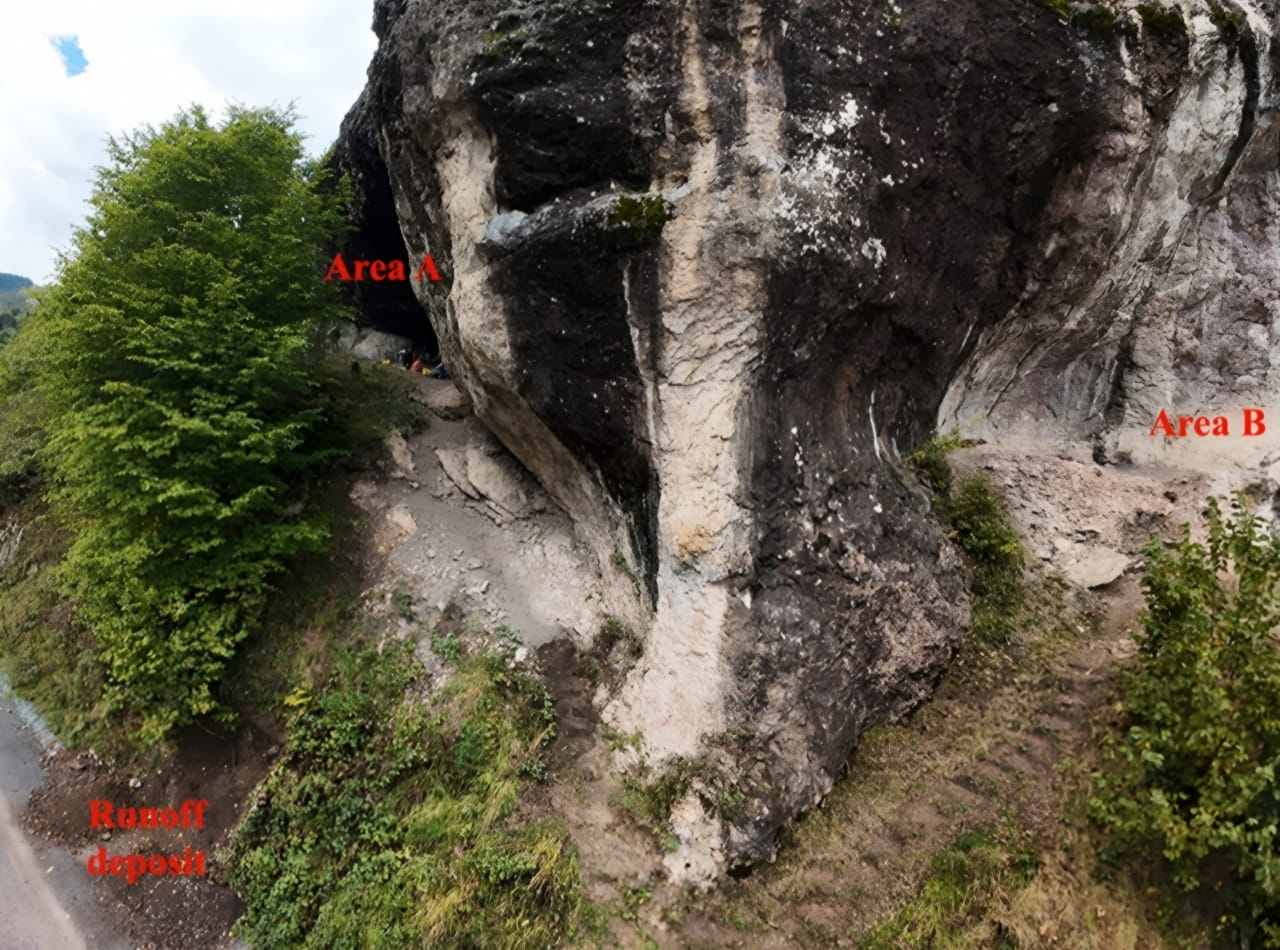
Koskarlı Cave in Türkiye has revealed an intact hunter-gatherer occupation dating to about 12,900 to 12,000 years ago. The find provides the first systematic evidence of Epipaleolithic occupation in the eastern Black Sea region.

Overview of Koskarlı Cave. Credit: Çalışkan Akgül et al., Antiquity (2026)
The cave lies about 40 kilometers south of Trabzon, in the Söğütlü Valley. It sits 1,030 meters above sea level and 24 meters above the Söğütlü Creek. Researchers first identified Koskarlı Cave in 2019. Systematic excavations began in 2024 under the joint direction of the Trabzon Museum and Karadeniz Technical University.
The excavation focused on three areas around and inside the cave. In the main trench, archaeologists examined 16 square meters. They found several layers, including a disturbed upper deposit containing both Epipaleolithic and much older Middle Paleolithic stone tools.
Below this mixed layer, the team found a 20 to 40-centimeter-thick deposit with an intact Epipaleolithic occupation. Fine grit, ash and carbonized material filled the layer. Burnt sediment and heat-altered flint also point to a fireplace used at the site.

a) Location of Koskarlı Cave. b) View of the landscape surrounding the cave. Credit: Çalışkan Akgül et al., Antiquity (2026)
Radiocarbon dates place the occupation between about 12,900 and 12,000 calibrated years BCE. The stone tool assemblage supports the same date. The finds include flint and obsidian artifacts, along with a small number of blades made from dacitic rock.
The toolmakers produced several types of implements at the cave. The assemblage includes cores, blades, bladelets, end-scrapers, backed blades, points, perforators and burins. Researchers also found small crescent-shaped tools known as lunates.
Four lunates show a type of bifacial retouch known as Helwan retouch. Similar tools occur at other Epipaleolithic sites, including sites in Anatolia and the wider eastern Mediterranean region. Their presence at Koskarlı adds to evidence for links between groups living across these areas.

Selection of artifacts: a & b) cores. c & d) end scrapers. e) Microgravette point. f) pointed backed blade. g) lunate. h) lunate with bipolar backing. i & j) lunates with Helwan-type retouch. k) grooved antler pendant. l) animal tooth pendant. Credit: Çalışkan Akgül et al., Antiquity (2026)
The stone artifacts also point to contact between the eastern Black Sea region and areas farther south and east. Some tool types have parallels in southern and central Anatolia, the Levant and the Caucasus. Koskarlı therefore offers a new site for studying how hunter-gatherer groups moved and shared technologies during the period.
The excavations also recovered objects linked to personal adornment. These include a grooved antler fragment and a pierced animal tooth. Researchers found faunal remains and land snail shells as well, although further study is needed to identify the remains.
The site fills a major gap in the archaeological record of northern Anatolia. Research on the Anatolian Epipaleolithic has focused mainly on southern regions, while little evidence has been available from the eastern Black Sea coast.
Koskarlı now provides a dated archaeological record from the transition between the Late Pleistocene and Early Holocene. The site offers new evidence for hunter-gatherer life in a region previously lacking systematic data from this period.
Publication: Çalışkan Akgül, H., Gündüzalp, S., Kandemir, R., Turan, D., Kıvrak, H. U., Chkhatarashvili, G., & Alnıak, L. (2026). Koskarlı Cave: excavations at an Epipalaeolithic site in the eastern Black Sea region of Türkiye. Antiquity, 1–8. doi:10.15184/aqy.2026.10410