Thousands of years ago, communities in Colombia’s Caribbean lowlands built one of South America’s largest water systems. New research shows local groups likely worked together without a powerful ruler directing the work.

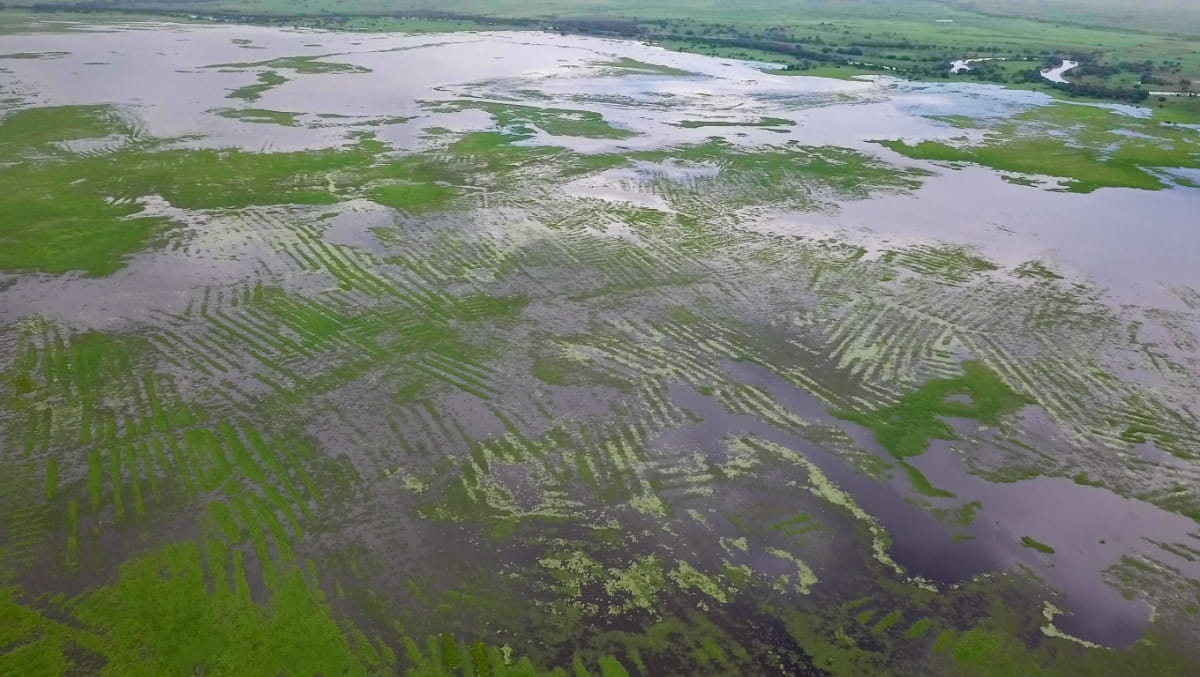
The canals and raised fields of La Mojana during wet season. Credit: Nicolás Jiménez, ICANH
The pre-Hispanic field systems of La Mojana covered more than 500,000 hectares. The network included raised fields and canals, with use dating from the first centuries BCE to about the 11th century CE.
For years, archaeologists linked such huge works with strong leaders and central control. The new study, published in Communications Sustainability, points to a different form of social organization. Local groups could have joined forces, shared work, and built major waterworks in a short time.
Researchers focused on a 500-hectare section near San Marcos in Sucre. Satellite images helped map 1,600 raised ridges and 63 housing platforms.
When first built, the ridges stood about 1.4 meters above the lowest parts of nearby canals. The canals moved water around the raised fields and homes. During heavy rain, the network helped manage excess water. During dry months, water could move back through the landscape.
The system also changed the soil used for farming. Raising the fields placed crops above wet ground and brought richer soil to planting areas.

Archaeologists from the Colombian Institute of Anthropology and History (ICANH) recording an excavated section of a pre-Hispanic canal-ridge formation. Credit: ICANH
The research team developed a new way to estimate the work needed to build and repair the fields. Their model included moved earth, local soil, population size, tools, and known farming practices.
The results point to a much lower labor demand than earlier views suggested. With a local population of about 1,600 people, the researchers used 800 workers as a conservative estimate. A single canal and ridge system could have been built in less than two months, within about half of one dry season.
Heavy clay soils made digging hard, and workers lacked metal shovels.
The findings challenge a common view of pre-Hispanic societies in the region. The people who built the fields lived during the same broad period as Maya societies and later Andean states. Yet archaeologists have found no evidence of state-level government in the study area.
Gold objects and fine pottery once helped support ideas about powerful local chiefs. The new labor estimates suggest such objects don’t prove central authority. Large public works could grow from cooperation among local families and communities.
Maintenance also appears to have required little labor. Full restoration once in a generation would take only a few days of work each year, according to the study. The scale of the system alone therefore offers no clear proof of top-down rule.
La Mojana still faces severe problems with floods and drought. Modern flood works have often aimed to block water instead of working with the area’s natural flow. The Caregato dyke has suffered repeated breaches since 2021, causing losses for local communities and damage to wetland ecosystems.
The ancient system offers another approach. Raised fields and canals spread and stored water across the landscape instead of trying to block its movement. Local communities could organize such work with state funding and support while keeping control of the system.
The raised fields stopped being used before Spanish arrival in the 16th century, though the reason remains unclear.
Publication: Vieri, J., Montejo Gaitán, F., Carrero-Pazos, M., & Martinón-Torres, M. (2026). Collective labour and sustainability of pre-Hispanic field systems in La Mojana. Communications Sustainability, 1(1). doi:10.1038/s44458-026-00128-5
More information: University of Cambridge
Leave a Reply