Early Neolithic cereals grew larger in parts of southwest Asia because of wetter growing conditions, rather than human selection through tilling. A new study combines plant remains, carbon isotopes and weed evidence to trace how cereal domestication began in the southern Levant.

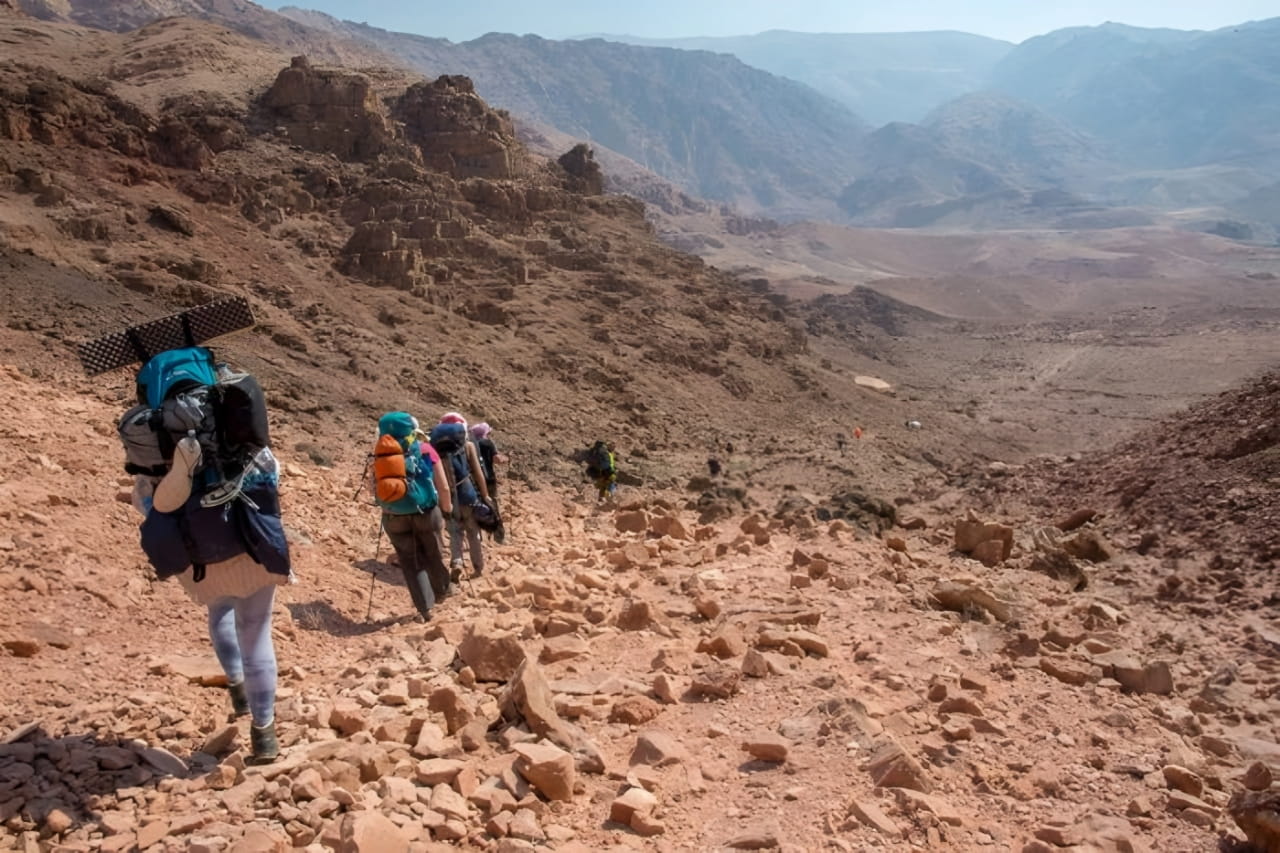
The Sharara team hiking to the excavation. Credit: Jerome Poulalier, http://www.jerome-poulalier-photography.com
Larger grains have often been treated as an early sign of human selection, since domesticated cereals tend to have larger seeds than wild plants.
The new study points to a different process. Researchers examined cereal remains from three archaeological assemblages at Sharara and el-Hemmeh in Jordan.
Wild barley and emmer wheat have a brittle rachis. Once the plants mature, this structure breaks apart and lets seeds fall to the ground. Domesticated cereals later developed a tougher rachis, which keeps the grains attached to the ear and makes harvesting easier.

Professor Cheryl Makarewicz, senior author of the study, investigating a early neolithic domestic structure at Sharara. Credit: Jerome Poulalier, http://www.jerome-poulalier-photography.com
Grain size followed a different path. At the early sites, barley and emmer wheat still showed wild forms of the rachis. Yet some grains were much larger than others. A few reached sizes similar to those found in later domestic cereals.
Researchers tested whether cultivation explained the difference. They used stable carbon isotope analysis on charred grains. Carbon isotope values in cereal remains preserve information about water stress during plant growth. The results showed a clear link between moisture and grain size.
Larger barley grains had isotope values linked with wetter growing conditions. Smaller, wild-sized grains showed signs of greater water stress. Water availability therefore had a strong effect on the size reached by individual plants.
The team also studied weed remains from the same sites. Weeds associated with the cereals pointed to low-disturbance settings rather than fields exposed to heavy tillage. The plant evidence therefore offers little support for a model where repeated soil disturbance drove early grain growth.

First author Jade Whitlam carrying out flotation of the Sharara charred seeds in the Wadi el-Hasa. Credit: Jerome Poulalier, http://www.jerome-poulalier-photography.com
Jade Whitlam of the University of Oxford led the study. She said the combined evidence points to developmental plasticity as the main cause of early grain size changes. In simple terms, the same plant type produced different grain sizes as growing conditions changed.
This distinction matters for understanding the path from wild plants to crops. A larger grain does not always signal a genetic change or human selection. Environmental conditions first altered plant form, while later cultivation helped drive inherited changes.
The study suggests cereal domestication unfolded in stages. Early plant management formed part of a longer shift in how hunter-gatherers used and shaped local environments. Genetic selection for larger grains likely came later, after selection for cereals with a nonshattering rachis.
Morphological traits alone might suggest domestication was already underway. Adding isotope data and weed ecology gives a fuller picture of the conditions in which those traits developed.
Early communities managed wild cereals for generations before the plants showed the full set of traits linked with domestication.
The study provides a new sequence for cereal evolution in the southern Levant. Environmental effects on plant growth came first. Genetic selection linked with cultivation followed later, helping shape the cereals that became central to farming.
Publication: Whitlam, J., Flohr, P., Bogaard, A., Charles, M., Finlayson, B., & Makarewicz, C. A. (2026). Developmental plasticity under human management shaped cereal evolution prior to domestication in the Early Holocene southern Levant. Proceedings of the National Academy of Sciences of the United States of America, 123(32), e2535274123. doi:10.1073/pnas.2535274123
More information: ROOTS Cluster of Excellence at Kiel University
Leave a Reply