Six copper bells found at an ancient Yampara site in Bolivia formed part of a carefully arranged ritual offering.

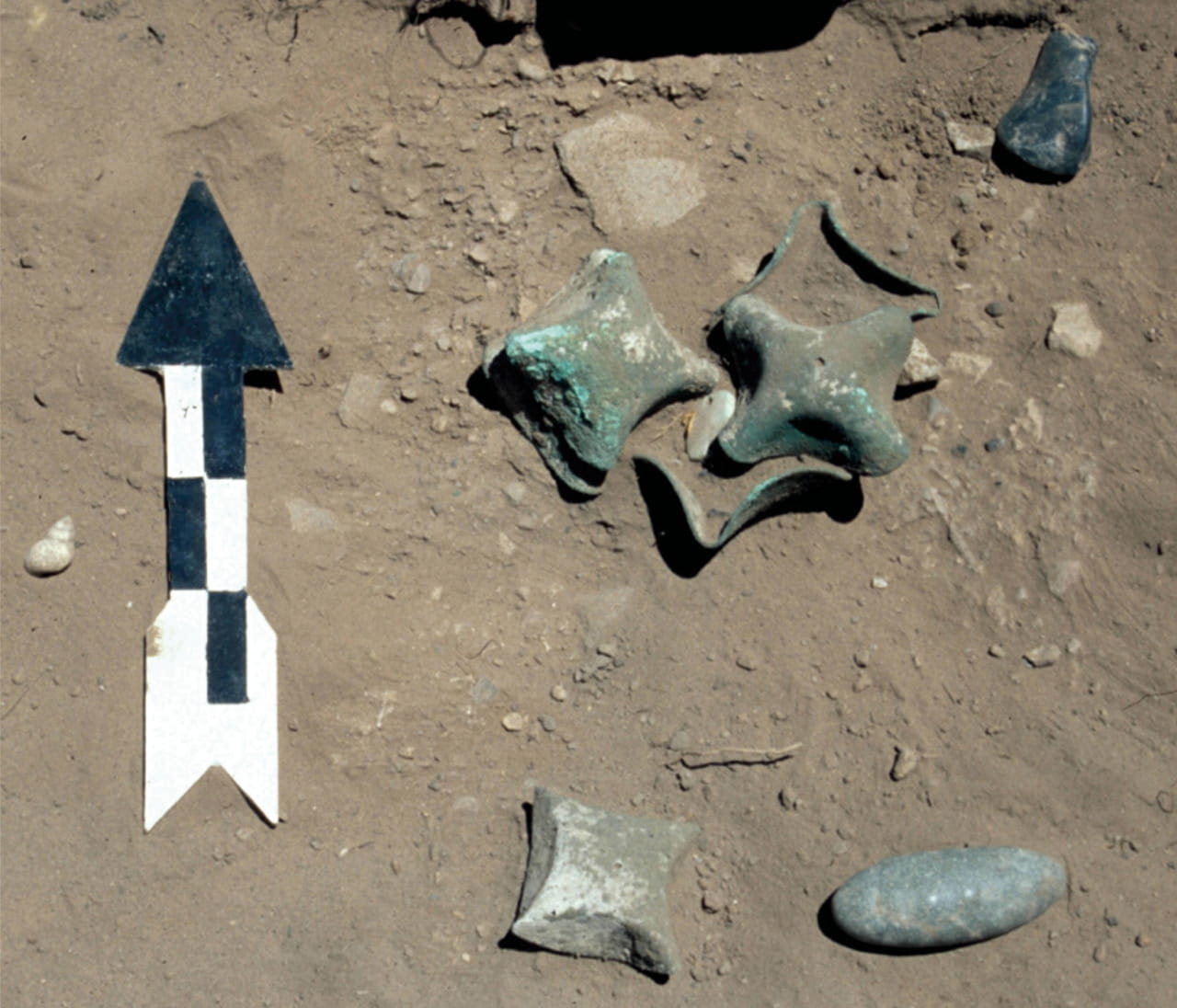
The ritual offering R-205 deposited in a qollqa storage structure. Credit: Alconini, S., & Sánchez-Canedo, W., Cambridge Archaeological Journal (2026)
The bells came from Yoroma, a large settlement in the Oroncota Valley. During the Inca imperial expansion (CE 1300–1536), Yoroma served as an important Yampara center.
Researchers found the bells inside a circular storage building known as a qollqa. The structure held crops, linking the find with food storage and farming.
The bells sat together with several other objects. These included a stone carving shaped like a maize ear, a polished stone, a stone axe, and a complete land snail shell.

(a) carved conopa maize ear; (b) stone axe; (c) basalt polisher; (d) Guácara terrestrial shell (Megalobulimus oblongus); (e) undefined. Credit: Alconini, S., & Sánchez-Canedo, W., Cambridge Archaeological Journal (2026)
The group had a clear arrangement. The six bells formed the center, while the other objects sat around them. Shell fragments, pottery pieces, and ash also appeared within the deposit.
The bells had a folded, four-sided pyramid shape. Their sizes differed, with lengths ranging from 9.3 to 10.4 centimeters. Their weights ranged from 50 to 186 grams.
Each bell also had a different type of clapper. The researchers grouped them into three sets based on these parts.
The first group held one small bell with a stone clapper. The second group had two bells with copper clappers. The third group contained three bells with stone and shell clappers.

The reconstruction shows the possible use of copper bells as musical instruments (R-205). Credit: Alconini, S., & Sánchez-Canedo, W., Cambridge Archaeological Journal (2026)
The different clappers produced different sounds. Some produced sharper metallic tones, while others created softer sounds.
The bells also differed in their metal makeup. Tests found between 92 and 96 percent copper, with tin making up between 2 and 5 percent. Small amounts of arsenic, nickel, and iron were also present.
The metal mix gave the bells useful physical qualities. Tin helped make the copper stronger and more durable. The bells also had bright surfaces.
The study links the bells with rituals focused on harvests, fertility, and abundance. Their place inside a crop storage building adds another link with farming.
The maize carving also held a clear connection with crops. Researchers identify the object as a conopa, a stone figure linked with fertility and household protection.

Northern ridge residential compound. Above: circular construction (St-35); behind is the Pilcomayo River. Below: Funerary urn recovered in St-3 part of the same compound. Credit: Alconini, S., & Sánchez-Canedo, W., Cambridge Archaeological Journal (2026)
Other objects brought different meanings into the offering. The polished stone was identified as a raya rumi, a stone associated with healing and lightning. The land snail shell also held a role in ritual practice.
The bells themselves had more than one role at Yoroma. Two smaller copper bells were found elsewhere at the site. One came from an elite residence, while another came from a structure interpreted as public.
Those smaller bells were about three centimeters wide. Their size suggests a different use from the larger bells in the ritual deposit. Such small bells served as ornaments and likely attached to clothing, belts, or hair.
Their sound would have changed as people moved. This made the bells part of dress as well as personal display.
The researchers also link the Yoroma bells with later Yampara traditions. Among Jalq’a and Tarabuco communities, bells and metal sounds still form part of the Carnival celebration of Tata Pujllay.
The study points to sound as an important part of Yampara ritual practice. The bells produced different tones, while their copper surfaces and shapes added other qualities.
The objects also show links between distant parts of the southern Andes. Researchers suggest the copper bells came from areas around Tarija, northwestern Argentina, or northern Chile.
The land snail shells came from another region and were traded across the Andes. Their presence beside the bells shows how objects from different places entered the same ritual setting.
At Yoroma, these materials came together inside a building tied to crop storage. The placement of the bells connected sound, objects, farming, and ritual practice.
The study presents the copper bells as musical objects and as parts of Yampara ritual life during the Inca period.
Publication: Alconini, S., & Sánchez-Canedo, W. (2026). Sacred sounds, exchange, and copper bells in the ancient southeastern Andes: The yamparas and Inka empire. Cambridge Archaeological Journal, 1–18. doi:10.1017/s095977432610064x
Leave a Reply